


The Movement is structured around a five‑stage formation architecture that develops identity, purpose, order, leadership, and legacy. Each stage builds on the last, creating the internal framework required for generational repair and long‑term reformation.
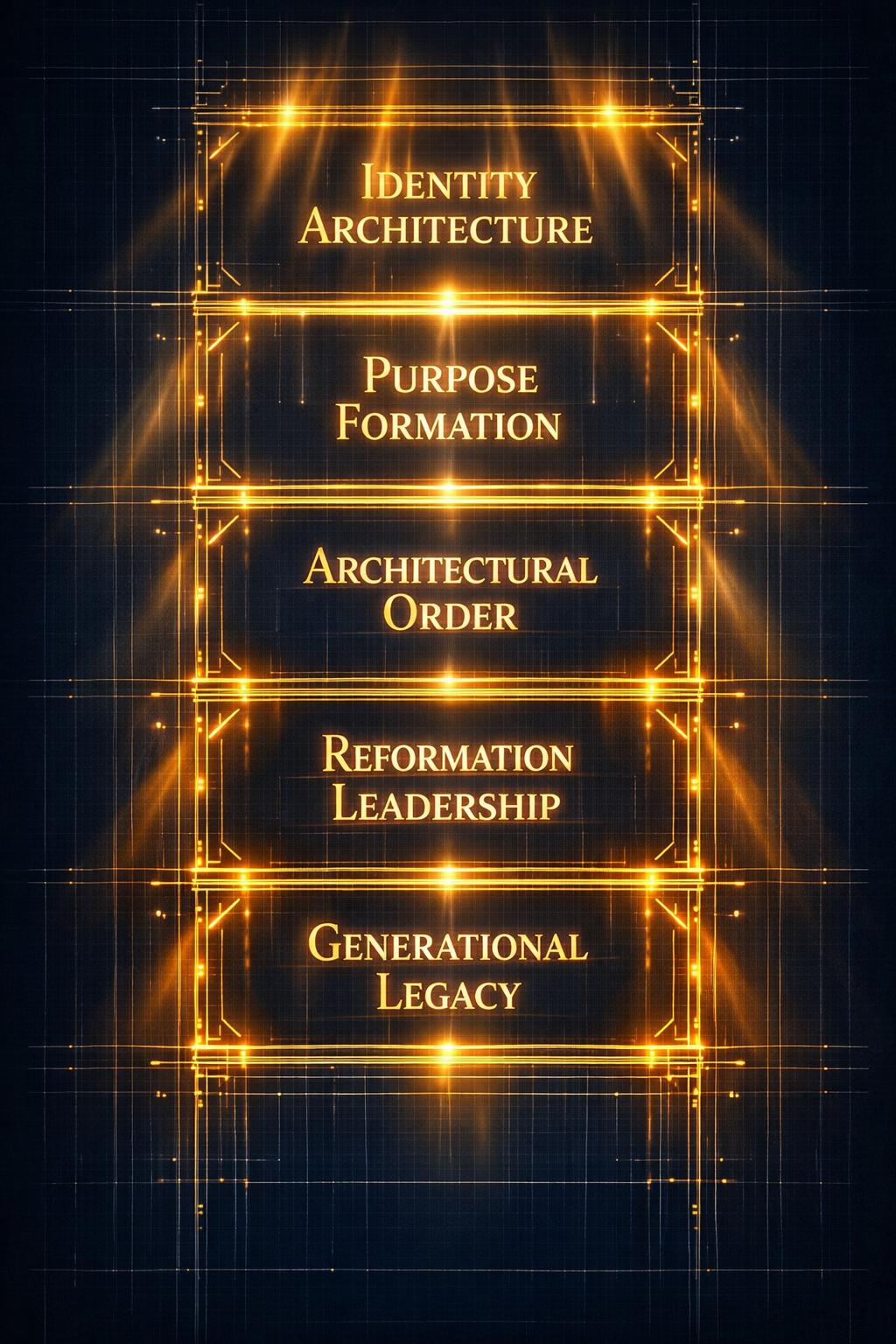
Formation Architecture
The formation pathway that prepares a person to carry generational repair.
- Identity Architecture — the revealed design a person is built from
- Purpose Formation — the assignment that emerges from identity
- Architectural Order — the structure that protects purpose
- Reformation Leadership — leadership that heals rather than extracts
- Generational Legacy — the inheritance that continues beyond a lifetime
The Seven Intelligences
The Seven Intelligences help you understand how you’re uniquely designed. They reveal the way you think, perceive, build, and lead — giving you language for your identity and clarity for your assignment. When you know your intelligences, you know how you were meant to move through the world.
Once you understand how you’re wired, the next step is seeing how your identity, story, and transformation fit together. The Pillars of the Movement outline that journey.
The Pillars of the Movement
- Identity — Understanding who you are and how you’re wired.
- Redemption — Healing the story you’ve lived so far.
- Reformation — Becoming the person who breaks cycles and builds new ones.
The Pillars outline the journey; the Expressions show where that journey takes shape. These are the spaces where identity is discovered, healing unfolds, and reformation becomes real.
Expressions of the Movement
The Expressions form the systems where identity is revealed, story is healed, formation is built, and generational leadership is developed. Each expression supports a different layer of the movement’s architecture.
- The Trilogy — The identity, redemption, and reformation pathway that forms the internal architecture of a person.
- The Seven Intelligences — The diagnostic framework that reveals your wiring and clarifies your identity.
- The Intelligences Test — The assessment that locates your design and maps your primary intelligences.
- The RISE Academy — The formation environment where identity becomes transformation and order is established.
- Coaching — Personalized identity and story alignment for individuals, leaders, and reformers.
- Courses — Guided teaching and transformation experiences that deepen identity and strengthen formation.
- The Architecture Trilogy — The system-building layer (Books 4–6) that forms reformers and movements. Nation → Reformer → Movement.
- The Dominion Trilogy — The governance layer (Books 7–9) that establishes generational stewardship. Consecration → Commissioning → Dominion.
The Expressions outline the systems of the movement; the Glossary defines the technical language those systems rely on. These terms form the lexicon of the identity architecture framework and anchor the movement’s conceptual precision.
A Glossary of Core Language in the Identity Architecture Framework
This page introduces the foundational terms that shape the movement. Each word carries meaning, structure, and intention — helping readers understand the architecture behind identity, transformation, and generational renewal.
Identity Architecture Framework
The integrated system of identity, redemption, reformation, and the Seven Intelligences that reveals how a person is built, healed, aligned, and commissioned. It is the blueprint for personal transformation and generational renewal.
Identity Architecture
The process of understanding how a person is internally built — their wiring, intelligences, patterns, and meaning‑making structures — so they can live from clarity instead of reaction.
Blueprint
Heaven’s design for your legacy. Not just a plan — but a prophetic pattern. You don’t just build — you align.
Seven Intelligences
A multi‑dimensional model describing how people naturally perceive, process, and interpret the world. Each intelligence reveals a different layer of a person’s internal architecture.
Movement
A sustained, generational work of God built on identity, alignment, and obedience. A movement multiplies Reformers, establishes culture, and carries transformation across families, cities, and nations.
Reformer
One who has undergone identity transformation and now rebuilds what was broken in families, systems, and generations. A Reformer carries clarity, authority, and assignment — building what aligns with Heaven’s design.
The Trilogy
The three‑book formation pathway — Identity, Redemption, Reformation — built on the 3‑5‑7 biblical pattern to break generational cycles and commission emerging leaders.
Architecture Trilogy
Books 4–6 of the canon — the system‑building layer that establishes the structures, patterns, and blueprints that sustain identity, redemption, and reformation.
Dominion Trilogy
Books 7–9 of the canon — the governance layer that purifies authority, commissions leaders, and establishes generational stewardship across territories.
Narrative Intelligence
The ability to understand life through story, symbol, metaphor, and meaning. People with this intelligence see patterns in events and interpret their lives through narrative arcs.
Architectural Intelligence
The ability to see systems, structures, frameworks, and patterns beneath the surface. These individuals think in layers, build models, and intuitively understand how things fit together.
Generational Patterns
Inherited emotional, behavioral, or relational cycles that repeat across family lines until someone becomes conscious enough to interrupt and redirect them.
Outer Court / Inner Court
Outer Court: the visible, active, doing season.
Inner Court: the hidden, refining, identity‑shaping season.Forge
The intense season where identity is consecrated, strengthened, and reshaped. It is not punishment — it is preparation.
Altar
Sacred spaces of surrender, obedience, and commissioning — where people encounter Jesus. You don’t just build platforms — you prepare places where Heaven meets earth.
Transformation
The internal work God does in you. It is the identity‑level rebuilding where the Holy Spirit restores what was broken, heals what was wounded, and renews what was distorted.
Redemption
The restoring work of Jesus that rewrites your story with truth, identity, and purpose. Redemption is not erasing your story — it is retelling it through the eyes of Heaven.
Reformation
The external work God does through you. It is the generational, structural, and cultural rebuilding that flows from a transformed life.
Transformation vs. Reformation
Transformation: God rebuilding you — the internal, identity‑level work.
Reformation: God rebuilding through you — the external, generational work.
Core Distinction: Transformation changes the person. Reformation changes what the person builds.Mantle
A mantle is Heaven’s commissioning for impact. It carries identity, authority, and responsibility. It shifts atmospheres, silences noise, and marks you with Heaven’s presence.
Revivalist Mantle
Heaven’s commissioning to carry fire and presence into families, cities, and generations. It forges obedience, multiplies legacy, and sustains atmospheres of healing and surrender.
Commissioning
The release of light into the world through sending — the Great Rescue Mission. As the disciples were sent, so are you.
Legacy Directives
A mantle‑specific assignment released to activate, align, and multiply generational impact. Not just guidance — it’s Heaven’s commissioning.
Revivalist
One who carries the presence of the Holy Spirit with intimacy and obedience, prepares atmospheres where healing remains and legacy multiplies, and becomes the flame rather than speaking it.
NextGen Revivalist
Not defined by age but by assignment. Formed now to carry His presence with purity, obedience, and endurance. They revive identity, rebuild altars, and embody revival as a lifestyle.
Atmospheres
The spiritual climates you cultivate through obedience, worship, and prophetic alignment. These are spaces where healing, identity, and legacy are activated.
Ecosphere
The living sphere sustained by His Presence, where identity is revived, purpose is forged, and legacy multiplies. It is immersion, convergence, and invitation.
Creative
One who builds with Heaven’s imagination and multiplies legacy through expression. Creativity is revelation — an offering that becomes a gate for families, cities, and nations.
Culture
The spiritual norms, values, and practices you establish through language, honor, and fire. It’s what you normalize, release, and multiply.
Movement Builder
A Movement Builder architects legacy through systems, strategy, and spiritual obedience. They don’t just carry fire — they build the frame that holds it.
Multiplication
The increase of light through spiritual reproduction.
Legacy
The spiritual inheritance you build and defend through discipleship, obedience, and generational impact. It is not just what you leave — it is who you multiply.
Generational Renewal
The covenantal rhythm where faith, fire, and obedience are passed from one generation to the next. Renewal breaks cycles, restores families, and builds altars for future generations.
Reformational Revivalist
One who carries the fire of revival with the architecture of reformation. They awaken identity, restore spiritual order, and build structures that sustain transformation across generations.
Kingdom Architect
One who interprets, designs, and builds spiritual structures that align people and nations with God’s order. Their work is blueprint‑level: structural, generational, and rooted in the wisdom of the Spirit.
Builder of Generational Order
One who restores the alignment of identity, responsibility, and inheritance across family lines and spiritual lineages. They build systems that outlive them, ensuring transformation becomes legacy.
Identity Roles
These roles describe how a person’s design expresses itself in the world. They are not titles, positions, or platforms, but structural identities that emerge from alignment, consecration, and internal order. True identity roles build, strengthen, and mature communities; false identity roles collapse under pressure because they are formed from wounding rather than design. This category clarifies the difference between legitimate authority and distorted expressions that imitate it.
True Fivefold Identities
The five structural roles (apostle, prophet, evangelist, shepherd, teacher) that arise when a person’s internal architecture is aligned, consecrated, and operating from design. These identities steward authority without distortion, establish order within communities, and build systems that support generational formation. They are the legitimate counterparts to the false fivefold structures that collapse under pressure.
False Fivefold Identities
Counterfeit expressions of the apostle, prophet, evangelist, shepherd, and teacher that form when identity is shaped by wounding, performance, or unresolved story rather than design. These identities imitate authority but lack the integrity, order, and generational capacity of true architecture.
Book 7 exposes their structure, traces their collapse, and initiates the consecration that realigns identity for legitimate governance.
Legacy
Legacy is the generational architecture you build — the identity you establish, the order you restore, the blessing you secure, and the systems you construct that continue forming people long after you are gone. Legacy is the continuation of design across generations — the endurance of a structure.
Sobriety
Sobriety is the internal clarity required to discern truth without distortion, resist cultural pressure, and build from Kingdom design rather than reaction. It stabilizes identity, strengthens discernment, and protects the builder from emotional acceleration, cultural fog, and reactive formation.
Cultural Intoxication
Cultural intoxication is the internal distortion that occurs when a person absorbs the values, pace, emotions, and reactions of the surrounding culture until identity, order, and discernment are compromised. It replaces Kingdom clarity with cultural pressure, accelerates emotional reaction, and disrupts the ability to build with accuracy. Cultural intoxication is the opposite of sobriety — it bends perception away from design and toward distortion.
Reformational Revivalist — Personal Expression (Michael Meyer)
Michael carries the fire of God with the backbone of apostolic order. His mantle awakens purity, restores alignment, and strengthens the spiritual spine of those he fathers and forms.
Identity Absence
The internal vacuum created when identity was never modeled, never named, or never stabilized in childhood. Identity absence is not rebellion or confusion — it is a structural gap. Without a modeled identity, a person learns to survive through adaptation, performance, or emotional fusion rather than design. This absence becomes the root system for identity substitution, inherited shapeshifting, and identity drift, producing instability, role-hopping, and the collapse of internal architecture under pressure. Identity absence explains why people attach to roles, leaders, or spiritual intensity instead of anchoring into their own God-given design.
Identity Substitution
When a person adopts a role, assignment, or spiritual identity to compensate for an unformed internal identity. Identity substitution creates the illusion of clarity while masking the absence of true design. It often forms in environments where performance is rewarded, belonging is conditional, or identity was never modeled. Substitution collapses under pressure because it is built on role, not architecture.
Inherited Shapeshifting
A generational pattern where individuals change roles, personas, or identities to maintain belonging, avoid conflict, or stabilize emotionally chaotic environments. Shapeshifting forms when children must adapt to the emotional needs of caregivers rather than develop their own design. In adulthood, it appears as role-hopping, sudden reinvention, and the inability to anchor into a stable identity architecture.
Identity Diffusion / Identity Drift
A collapse of internal identity architecture that produces instability, boundary loss, and frequent reinvention. Identity diffusion occurs when identity is unanchored or never modeled, leading individuals to adopt new roles, callings, or personas to create a sense of relevance or control. Identity drift is the behavioral expression of this diffusion—seen in abrupt vocational shifts, spiritual role-hopping, relational enmeshment, and the fusion of personal and ministry life. These patterns signal the absence of a stable internal design and the presence of unresolved story, unprocessed emotion, or inherited identity absence.
Marriage Architecture
The structural design of a covenant where two distinct identities are aligned for a shared assignment. Marriage does not merge identities; it orders them. Each partner carries a unique design, formation timeline, and role within the covenantal architecture. Understanding this structure prevents identity absorption, role confusion, and the collapse that occurs when one partner minimizes their design to compensate for the other’s development.
Disclaimer: The concepts in this glossary describe spiritual and identity‑formation patterns within a theological framework. They are not psychological diagnoses and should not be interpreted as clinical categories. These terms are provided for educational clarity and spiritual formation, not therapeutic treatment.
The glossary is designed to support leaders in understanding the dynamics addressed by the Elijah mandate in the life of a leader. Individuals experiencing any emotional or mental‑health concerns should seek immediate support from qualified professionals.


